
Caden LeClair

Image: Lucas Law. Unsplash.com (2024).
Beyond the Screen: Is Online Learning as Effective as Traditional Learning?
A frequently asked question about online learning, is whether it is as effective as traditional in-person learning in preparing students. Online learning efficacy research looks at whether the learning outcomes of online, hybrid, or in-person learning are equal to face-to-face environments. Efficacy research is important because there is still some skepticism about online education.
According to the National Center for Education Statistics, in 2024 approximately 5.7 million college students were enrolled exclusively in online programs (NCES, 2024). In the field of education, distance learning is not new. In fact, online learning first began in the United States in the early 1960s.
The University of Illinois is credited with launching PLATO, an interactive computer system that allows students to interact through a network of interconnected computer terminals (Cann, 2012). Access to personal computers, the invention of the internet and MIT’s Open Course Ware project all helped to pave the way for increased accessibility and the development of more online courses. Technology has played a key role in shaping online education and making it more accessible to more students worldwide.
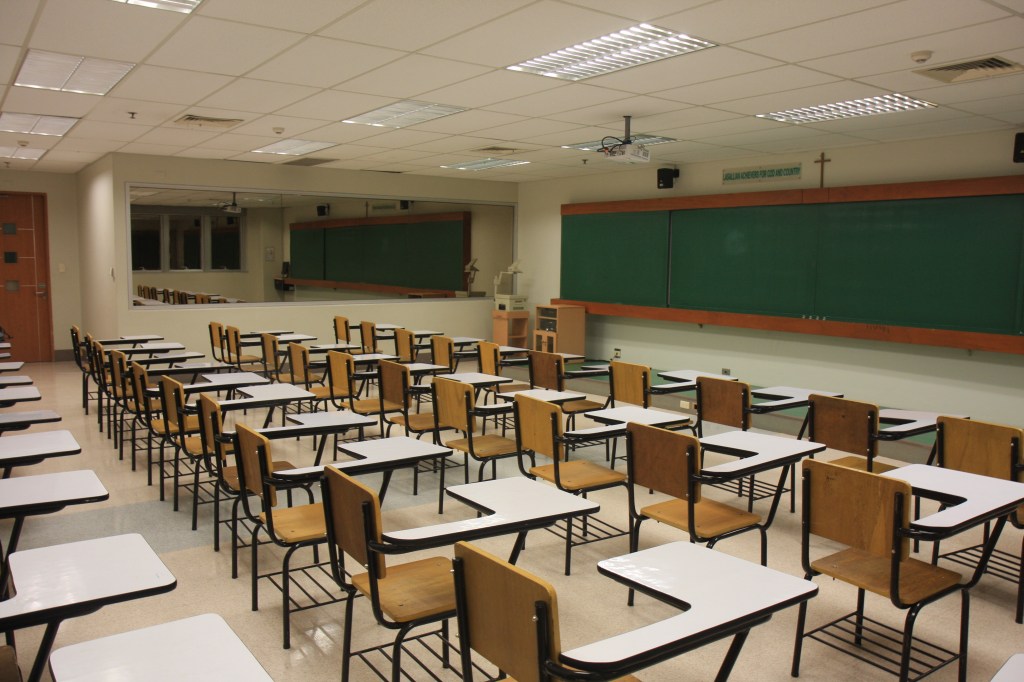
Image: Andrew Gonzales, De LaSalle University Classroom. Wikimedia Commons.
A Significant Shift
The COVID-19 global pandemic notably increased the widespread use of remote learning. Social distancing measures, required lockdowns, and school campus closures made full-time remote learning a reality for a large percentage of students nationally. The transition from traditional face-to-face learning to online learning during COVID-19 lockdowns was a significant shift in education (Bushra, et al., 2024).
The expansion of remote learning also allowed colleges and universities to extend academic degree programs to a broader, more diverse student audience. The difference between the theory and past studies showed that “online learning systems using digital platforms in schools could change education’s face to be innovative, more effective, and more attractive” (Tarigan et al., 2022).
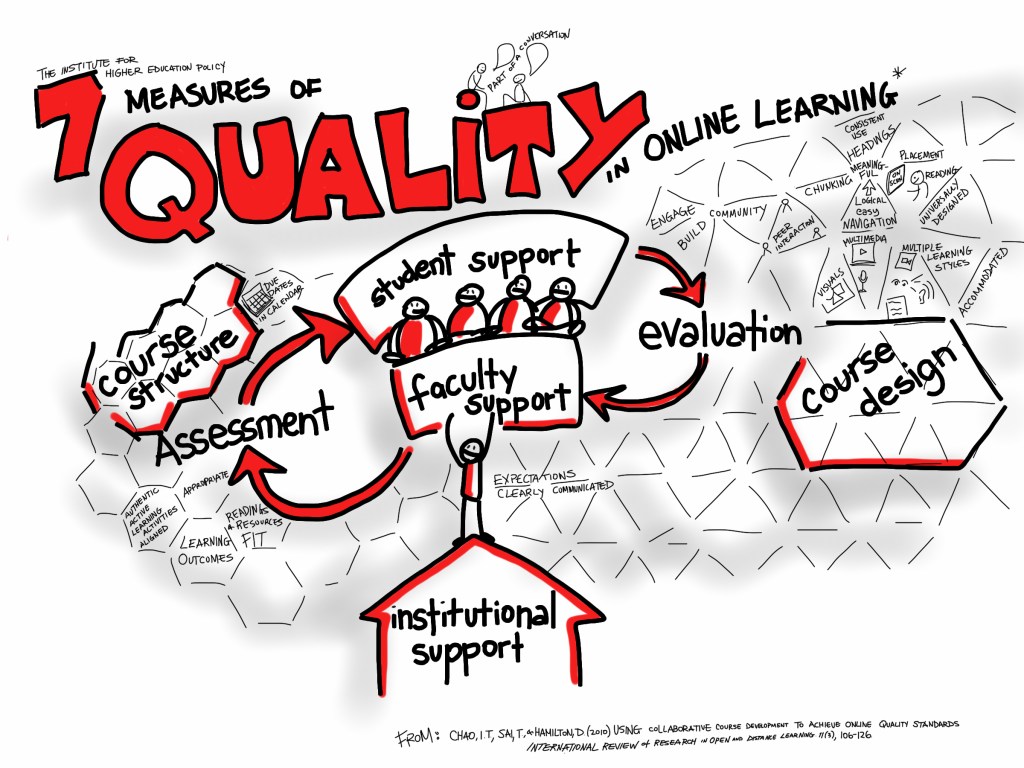
Image: Chao, I. T. (2010.). 7 Measures of Quality in Online Learning . Wikimedia Commons .
Advantages
Distance learning and traditional face-to-face learning both have pros and cons. Chief among the positives of online learning is convenience. It allows learners to study at a time and pace that works best for the student. It’s also flexible, making it easy to develop the curriculum necessary to teach any academic subject or professional coursework. Online courses can be developed, repeated, and scaled to add more online learners, making it a more affordable option than traditional face-to-face classroom instruction for both the college and the student. Distance learning is widely accessible to anyone with an internet connection and a computer.
Disadvantages
Online learning has periodically received criticism over the quality of instruction and faced questions about whether online programs meet the same rigorous accreditation standards as in-person programs do. Traditional classroom experiences depend, to a large degree, on the instructor. The same curriculum and course content can be delivered by two different instructors and have vastly different impacts on the students in the class. Elearning offers a level of consistency that is not achievable with traditional face-to-face learning. Compared to traditional learning, online learning can also present some potential social and cultural challenges. For example, for some students, online learning can be isolating due to the lack of face-to-face interaction. Others find the online environment more difficult to develop a sense of community. Given that instruction is delivered via a computer, it is possible for students to develop an over reliance on technology. Students without access to a computer or internet access are at a disadvantage. To address these challenges, “ongoing research focusing on identifying effective strategies and best practices for online learning is necessary.” (Bushra, et al., 2024).

Image: Freepik.com. (2024). Smiley-woman-holding-post-its.
Is Online Learning Effective?
According to Mary Ellen Dello Stretto, Ph.D, Director of Research for Oregon State University Ecampus program, “We do receive questions from faculty and students about whether online environments are equivalent to the face-to-face environment in terms of learning outcomes.” (Dello Stretto, personal interview, February 18, 2025). Dr, Dello Stretto stated that, “Research unequivocally shows that it all comes down to quality, not the modality, but the quality of the course, the curriculum and the instruction” (Dello Stretto, personal interview, February 18, 2025).
A report published by the University of Potomac found that “70% of students agree that online classes are better than traditional classroom settings” (University of Potomac). Research confirms this is true. According to the Department of Education, “students in online conditions performed modestly better, on average, than those learning the same material through traditional face-to-face instruction.” (Means et al., 2010).
Further, according to authors Schmid, Borokhovski, Bernard, Pickup and Abrami, after decades of research “examining the relative impact of technology on learning, attitude, motivation, and values consistently show significant, positive outcomes as compared with traditional classroom-based approaches (Schmid, et al., 2023).
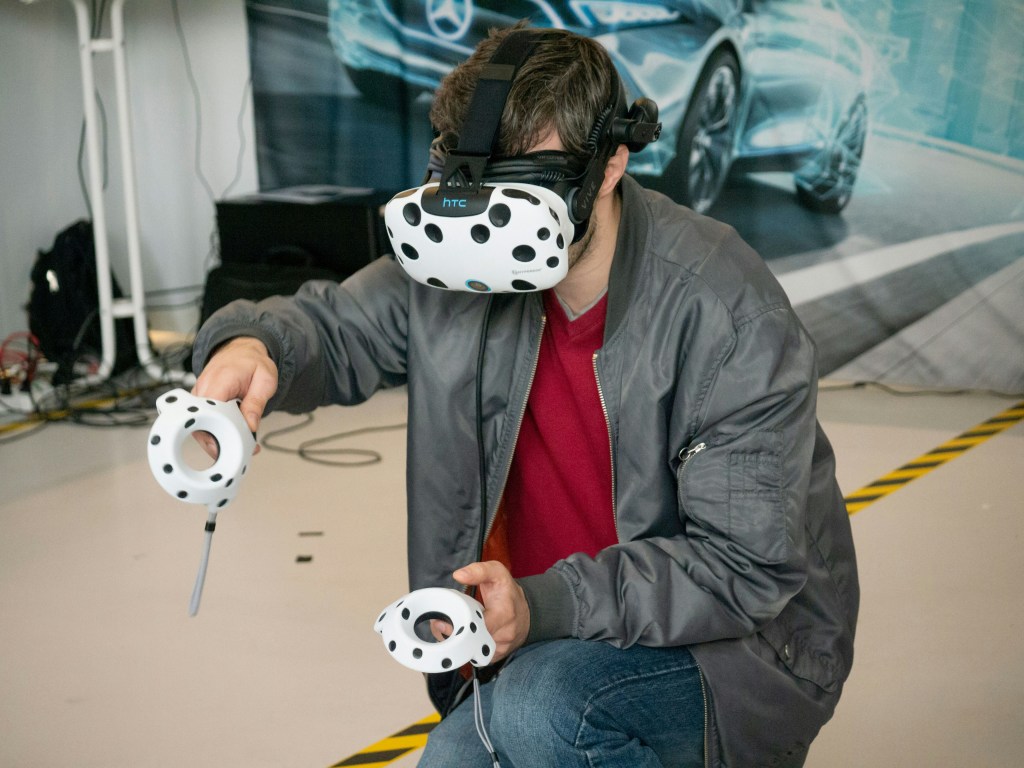
Image: Unsplash.com. (2024). Vr Free Image .
The Future of Online Learning
With continued advancements in technology, online learning is projected to grow exponentially. According to Shannon Riggs, Associate Vice Provost of Oregon State University’s Division of Educational Ventures, “Current research offers valuable insight that can help academic institutions like Oregon State in further decision-making about using immersive technologies in higher education.” (Riggs, personal interview, February 19, 2025).
New immersive learning technologies like virtual and augmented reality will help shape the future of online learning in new and exciting ways. According to Mary Ellen Dello Stretto, Ph.D, Director of Research for Oregon State University Ecampus program, “in some cases, immersive technology can add real value” further stating that, “exciting trends like micro credentialing and stacking offer new pathways in education, while projects using VR are currently being tested for future use at Oregon State University.” (Dello Stretto, personal interview, February 18, 2025).
According to Erik Brown, Creative Director at Stanford University Digital Education, “In an academic setting, immersive technology adds real value when you can transmit information, transport a learner or transform a concept.” (Brown, personal interview, February 20, 2025).

Why it matters
With continued advancements in technology, research, and data analytics, online learning is expected to continue improving and growing. More colleges and universities are prioritizing and expanding online degree programs, virtual classrooms, and professional development opportunities. Students embrace the flexibility, convenience, and affordability of online learning as a way to earn a college degree or even develop new career skills. The future of online learning certainly looks bright.
Sources
Alzahrani, Mojib. “Traditional learning compared to online learning during the COVID-19 pandemic: Lessons learned from Faculty’s Perspectives.” Sage Open, vol. 12, no. 2, 22 Apr. 2022, pp. 1–11, https://doi.org/10.1177/21582440221091720.
Brown, Erik. Personal Interview. 20 February 2025.
Cann, A. (2012). A ramble through the history of online learning: A personal journey. The Biochemist (London, England), 34(4), 8–11. https://doi.org/10.1042/BIO03404008.
Chao, I. T. (2010.). 7 Measures of Quality in Online Learning . Wikimedia Commons . Wikimedia Commons . Retrieved from 7_Measures_of_Quality_in_Online_Learning_(10164585803).jpg.
Chandler, David L. “Study: Online Classes Really Do Work.” MIT News | Massachusetts Institute of Technology, MIT News Office, 24 Sept. 2014, news.mit.edu/2014/study-shows-online-courses.
Dello Stretto, Mary Ellen. Personal Interview. 18 February 2025.
Freepik.com. (2024). Yes No post-its. Freepik.com. Retrieved March 2025, from https://www.freepik.com/free-photo/smiley-woman-holding-post-its_23994274.htm.
Gonzales, A. (2011). Classroom De LaSalle University . Wikimedia Commons . Retrieved February 2025, from https://commons.wikimedia.org/wiki/File:Andrew_Classroom_De_La_Salle_University.jpeg.
Law, L. (2024). lucas-law-ecELcxmJTk4-unsplash.jpg. Unsplash . Unsplash.com. Retrieved February 2025, from lucas-law-ecELcxmJTk4-unsplash.jpg.
Means, Barbara, et al. “A Meta-Analysis and Review of Online Learning Studies.” U.S. Department of Education , U.S. Department of Education, Sept. 2010, http://www.ed.gov/sites/ed/files/rschstat/eval/tech/evidence-based-practices/finalreport.pdf.
National Center for Education Statistics. (2023). Undergraduate Enrollment. Condition of Education. U.S. Department of Education, Institute of Education Sciences. Retrieved [1, Feb., 2025], from https://nces.ed.gov/programs/coe/indicator/cha.
Nguyen, Tuan. “The Effectiveness of Online Learning: Beyond No Significant Difference and Future Horizons.” MERLOT Journal of Online Learning and Teaching, Vol. 11, no. No. 2, June 2015, pp. 309–329.
Rasheed, Bushra, et al. “Comparative Study of Online and Face to Face Instructions.” Journal of Asian Development Studies, Vol. 13, no. No. 2, June 2024, pp. 1045–1055.
Riggs, Shannon. Personal Interview. 19 February 2025.
Schmid, Richard F., et al. “Computers and Education Open.” A Meta-Analysis of Online Learning, Blended Learning, the Flipped Classroom and Classroom Instruction for Pre-Service and in-Service Teachers, vol. 5, 15 Dec. 2023, pp. 1–13.
Tarigan, K. E., Elahi, E., & Stevani, M. (2022). Education Responses in Teaching during Covid-19: The Ongoing Result in Online Learning Implementations. Journal of Learning and Development Studies, 2(1), 9–30. https://doi.org/10.32996/jlds.2022.2.1.2.
University of the Potomac. (2024, July 16). Online learning vs traditional learning. University of the Potomac. https://potomac.edu/learning/online-learning-vs-traditional-learning.
Unsplash.com. (2024). Vr Image . Unsplash.com. Retrieved March 2025, from xr-expo-sTdZIYiWwuA-unsplash.jpg.
 Samayō Blog
